Website Renewal!

Yesterday, on January 7, 2026, I launched my renewed website. I am so happy that many people have already visited. Thank you very much.
(It includes a nostalgic visitor counter that notifies you when you hit a milestone number!)


This time, I built the website using a programming tool while giving various instructions to a Google AI agent called Antigravity.
Although I am a complete amateur with no programming skills, I managed to do it by persistently repeating the process of implementation, checking, and dialogue with the AI.

Since I don’t fully understand the underlying mechanics myself, I realized once again that engineers are doing something truly incredible. I have nothing but respect for them.

I spent most of my time implementing the mascot character who is almost always resident on the homepage. I’ve loved things like “desktop pets” since I was a child, and having wanted to make one myself someday, this is a dream come true. Please teach them some words—something might happen if they learn a lot…?
Also, for PC users, right-click, and for smartphone users, long-press to bring up the menu!

In this age of SNS dominance, I’m not sure if there’s much meaning in enriching a personal homepage, but I want to operate it as a place for relaxed information sharing, away from the speed of algorithms. I’d be happy if you could drop by to talk to Sūnya every once in a while. (Please bookmark the site!)


I also made this. A nostalgic banner for homepages—where it is hidden is a secret.

“Train Dreams”

I finally watched the film “Train Dreams” on Netflix, a title that had been on my mind for a while.
Set in early 20th-century America, it is the life story of a man born as an orphan who works as a seasonal laborer, laying tracks and logging forests.

The visuals, presented in a 3:2 aspect ratio, are stunning and immediately drew me in. The majestic trees and forests of Idaho, and the American laborers who fell them.

The protagonist, Robert, is a taciturn man who, despite being among those rugged workers, doesn’t exude a sense of “macho” bravado. He simply focuses on his seasonal work—laying railroads and clearing forests. He lives a modest life in a house he built himself with Gladys, the woman he fell in love with.

Yet, amidst that life, utterly irrational events repeatedly befall him and those around him. Racism, accidents, fires.
One never knows why these things happen. Robert is tossed about by life without ever finding the answers.

Perhaps it’s because they are cutting down 500-year-old giants, or perhaps because they have overlooked horrific racism…

That very “unknowability” feels like the essence of living itself.
Eventually, things become suspended in mid-air. I was deeply moved by the beauty of the story’s progression, finding something meaningful within that state of suspension.

Since the main setting is the forest, the depiction of the entanglement between humans and nature was superb.
The vast forest is described as something where “one cannot tell where it begins or where it ends,” which feels like the true essence of nature.
Because we find it impossible to accept the incomprehensible, we instinctively try to find beginnings and ends. And then, we lose our way.I watched the film wondering what it would feel like to truly let go of that habit.

The cinematography by Adolpho Veloso was so brilliant that I found myself following him on Instagram immediately.
As for the lead, Joel Edgerton—I kept thinking his face looked familiar, and then I realized he’s Uncle Owen from the “Star Wars” prequel trilogy! And Felicity Jones, who plays his wife, is Jyn Erso from “Rogue One: A Star Wars Story“!
I got excited all by myself, thinking, “This is basically a Star Wars spin-off!” Please do give it a watch.

Speaking of which, I heard that the Star Trek series are disappearing from Netflix. How irrational…
I was still in the middle of “Deep Space Nine”…

“How to Walk on Beast Trails”

I read “How to Walk on Beast Trails” (Written by Shinya Senmatsu, Little More, 2015), which I bought at the new “Bookstore YamaYama” located in a repurposed, former library in Tatsuno Town.

This is a collection of essays by an author who practices trap hunting in Kyoto, discussing Japanese nature from a hunter’s perspective. For each familiar animal like deer or wild boar, he shares insights into their ecology and hunting based on his own experiences. Living in Nagano, I have people nearby who hunt, yet this book allowed me to peer into a world I knew nothing about.

There is a wonderful part where he feels that he, as a hunter, is just another animal like his prey. He notes that once the hunting season has progressed and he’s acclimated, he can sense whether a catch has been made just by the atmosphere of the forest:

“It might sound extreme, but even a single displaced twig or one overturned leaf can convey the movement of the prey.” (Quoted from page 60 of the same book)

In a book I read previously, “The Wimp Anthropologist Goes to the Desert” (Written by Kodai Konishi, Yamato Shobo), there was a scene describing desert dwellers in India hunting by moonlight, while the author from Japan was bewildered, unable to see anything. It makes me realize that while technology brings many benefits, there must be various innate human abilities that we are losing in exchange.

I also loved the inclusion of hunting experiences and the history of animals living in satoyama (borderland forests) beyond just deer and boar—badgers, raccoons (they live in Japan too!), and various birds. I had no idea that the feral pigeon (dobato) came to Japan from around Europe during the Asuka period. The fact that these historical and ecological details are listed with precise citations makes the book even more captivating. The list of books I want to read just keeps growing!

Above all, I find it deeply moving how the author, Senmatsu-san, continuously grapples with the weight of taking an animal’s life, and how those swirling, unresolved thoughts are laid bare on the page. Furthermore, the chapter regarding the impact of radiation on wildlife following the Fukushima nuclear accident is profoundly compelling.

I remember feeling a strange joy when I spotted badgers and masked palm civets in Nakameguro during the COVID-19 pandemic when humans had disappeared from the streets. Flocks of feral parakeets, and abandoned turtles sunbathing along the Meguro River… even in the megalopolis, there is an ecosystem, and I used to watch it for hours.

Now, I take a walk every day in Nagano (for my diet!). I don’t necessarily go deep into the mountains, but I’ve seen a serow (it was so motionless I thought it was a piece of contemporary art left in the woods), and I occasionally spot deer, foxes, and badgers—mostly at night. There are troops of monkeys with their young, woodpeckers, and wagtails that fly as if guiding my way—yesterday, I even saw a grey wagtail. Its vivid yellow stood out beautifully against the forest. I’m not well-versed in plants yet, but I’m so happy that there are things I want to know right here in my daily life, and that this curiosity continues to grow.

New Year’s Eve

When I was little, I remember throwing a tantrum, insisting, “I absolutely have to see the first sunrise of the year!” My mother, however, explained that the “First Sunrise” (Hatsuhinode) is simply a sunrise that happens to occur on New Year’s Day, and as a phenomenon, it’s exactly the same as any other sunrise. With that, she brilliantly avoided the hassle of going out in the early morning. I remember how the fantasy of New Year’s—something I had held as a special, sacred thing—crumbled inside me at that moment. I really thought New Year’s was some kind of massive natural phenomenon involving the entire planet!

Thinking back, my family was quite dry regarding New Year’s. Even on December 31st, my parents would usually go to bed before midnight. Their stance on Coming-of-Age Day was, “Why should the government decide whether I’ve become an adult or not?” and celebrations like Christmas or birthdays stopped happening quite early on.
In short, it was a “party-pooper” household that didn’t buy into society’s collective fantasies at all.

As for me, I actually love the festive atmosphere of the city during Christmas and the year-end season. But I’m a bit bad with New Year’s Eve; it’s painful for me to have the “one-year” boundary forcibly shut down, and I find myself wanting to turn away from it. After all, every year is full of things I failed to achieve. Besides, don’t decide on a 365-day boundary on your own! Humans are so selfish! Cats aren’t aware of New Year’s! Out of such selfishness, I find myself making an effort to spend the day as normally as possible. Because of that, I kept working on my animation. Maybe I’ll write about that in the next diary entry.

On the 30th, at a local udon shop in Fujimi Town called “Yamayuri,” there was a live performance by the band “Kafka’s Ibiki,” consisting of Jim O’Rourke, Eiko Ishibashi, and Tatsuhisa Yamamoto. “Yamayuri” is an udon shop in an old folk house that also appears in “Evil Does Not Exist” (directed by Ryusuke Hamaguchi). It felt so good to be bathed in such great sound in such a wonderful place. Even though Fujimi is a small town, I’m truly happy that people organize wonderful events in various places.
After that, the drunkards of Fujimi Town gathered one after another at a recently opened karaoke snack bar at the quiet Shinano-Sakai Station, turning it into a giant year-end karaoke party.

On the 31st, I was tinkering with Blender since morning. From the evening, everyone remaining in Fujimi gathered at our place for a New Year’s Eve hand-rolled sushi party while watching Kohaku Uta Gassen*. I didn’t know many of the performers, but I was surprised by how cool everyone was. After all, the kendama and domino segments were incredibly exciting. Is Vaundy a person, not a band? It was also great to see Aina The End on Kohaku. Also, Kenshi Yonezu’s performance was incredibly cool (I always thought his name was pronounced “Genshi”). I was enchanted by Seiko Matsuda‘s singing voice (The 80s Legend!), and as usual, I questioned the Kohaku victory/defeat system.
Apparently, next year is the Year of the Horse. It reminded me that two Decembers ago, I was in Georgia, and there were many snake goods at the street stalls in front of the Bus station. When I asked why, they said, “Because next year is the Year of the Snake.” I was surprised to learn that Georgia also uses the Chinese zodiac! and also made me think that we almost never use the zodiac except during the New Year season.

After everyone left, I touched Blender until about 4 AM to erase the feeling of “New Year’s Eve” within myself and to forget about boundaries like “one year.” It was a very quiet night, and I worked until dawn.

*Kohaku Uta Gassen– Japan’s legendary New Year’s Eve TV special where top artists compete in a “Red vs. White (Female vs Male)” singing battle.

Blender: Learning Geometry Nodes🛠️

My upcoming animated film, “Night in the Eyewall“, is set on a stormy night during a typhoon.

Because of this, I need trees and forest leaves that sway realistically in the wind for the background. I figured if I could create them in Blender*, it would make the workflow much smoother…

To build a forest, if I were to model every single tree one by one… I’d never finish in a lifetime.
I thought about making a few patterns and copy-pasting them, but I was worried it might look a bit cheap.
So, I decided to use “Geometry Nodes”* to create a “Procedural Tree”—a versatile tool where I can adjust the trunk shape and the amount of branches and leaves just by tweaking parameters.

Geometry Nodes are built by connecting various “Logic Nodes” with lines. It feels a bit like programming, and since I had never touched it before, I was completely lost.
I asked Google’s AI, Gemini, to be my tutor, and we progressed step-by-step, question by question.
Gemini 3 is incredibly capable with almost no misinformation, and it actually worked! Moreover, it explained the function of each node in detail as we went along, so I think I’ve grasped at least the absolute basics of Geometry Nodes.

I can adjust the height, the curvature, the number of branches, and more.
With this, I can place various iterations of trees on the screen, so it shouldn’t look unnatural. Now, I need to make a coniferous version too.

While I was at it, I also tried using Geometry Nodes to recreate the grass in the forest swaying in the wind.
Physics simulations can be very heavy on the PC, so I want to avoid them as much as possible.

The grass and leaves are simply drawn with a brush. It gives them an analog vibe, which is quite cute.
The length, color, and other attributes are adjusted to vary randomly.

With Geometry Nodes alone, the planes just ended up wobbling back and forth.
So, I also used the Wave Modifier on the base assets to create a rippling effect.

I hope it looks like a somewhat strong wind is blowing.


The full view of the “Procedural Tree” Geometry Nodes.
Blue is the trunk, yellow is the branches, red is the sub-branches growing from them, and green is the leaves.

I built it by combining commands like: “give the line a surface,” “make it taller,” “taper the tips,” “make it curvy,” “set the number of branches to X,” “set the branch direction/angle to…” and so on.

*Blender… A world-famous **free** software that can do almost anything related to 3D.
*Geometry Nodes… A feature that allows you not just to model an object, but to create the “recipe” for the construction itself.

I’ve added a “Hangar” for Sūnya the WebPet

*WebPet Sūnya said “I thought I was in another world!”
when I tucked Sūnya into the hangar.

Sūnya, the WebPet, is programmed to wander around the site at a certain probability (the “Stroll” feature).

While it looks adorable on a PC, I thought it might be a bit distracting on mobile screens.

So, I’ve prepared a “Hangar” inside the menu. If you tuck Sunya away there, they will only speak when you open the menu.

I’ve also written some exclusive lines for the Hangar, so please give it a try.

In this age of social media, WebPet Sunya is a little extra touch I created in hopes that people can still enjoy personal websites.

Social media has accelerated algorithm-driven echo chambers, swallowing society whole in its momentum.

WebPet Sūnya learns words taught by someone and repeats them in conversation.
You won’t know exactly who taught them those words.
But it might be nice to imagine that “someone” through Sunya’s voice.

This is a place for the internet, without all that frantic momentum.

Web Pet Sūnya

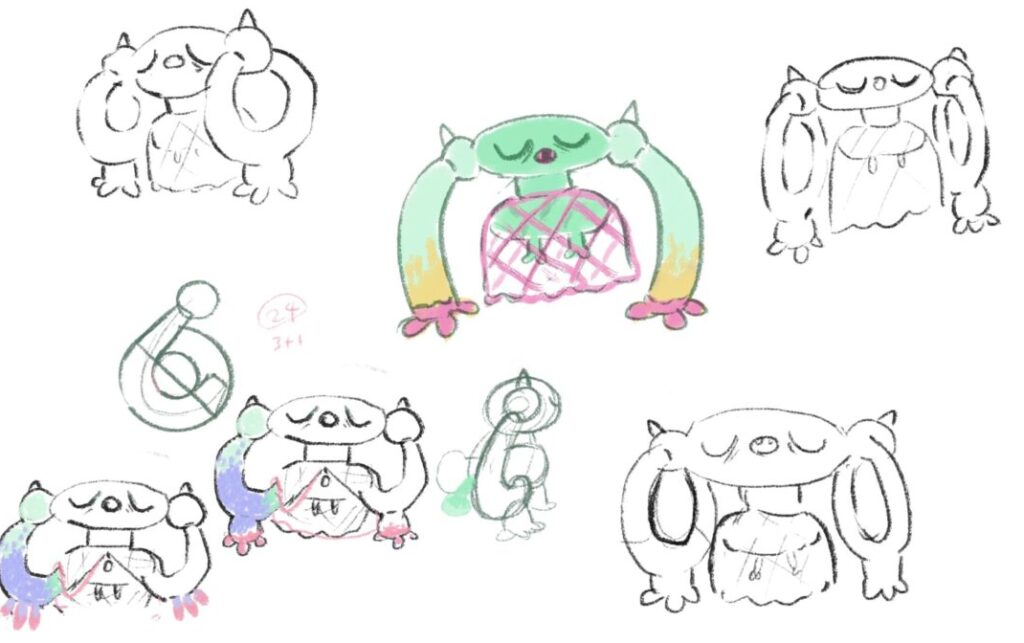
I can’t help but keep working on my web pet project. I’ve finally given it a body! Its name is “Sunya.”

Left: A sketch of Sunya in its early stages.

Right now, it just floats around aimlessly, but I’m planning to add all sorts of actions over time. I’m honestly so moved that I can now use AI to help me create my own digital pet—something I was so obsessed with as a child.

Sunya is a “Digital Ghost Unicorn.” The concept is that Unicode U+0966 [०] (the Sanskrit symbol for zero, or “Shunya” / void) glitched out and became a sentient ghost. Since it’s a “Zero (Void)” born from “Unicode,” it became a “Uni-code Corn” ghost—yes, it’s a pun!

It’s a friendly ghost that now haunts this homepage, eager to make friends with everyone.

Please, everyone, I’d love for you to answer its many questions!

Site renewal & digital pet in progress

I’m currently working on renewing my official website, developing it bit by bit. Although I have zero technical expertise, my friend Kohei introduced me to a Google development tool called Antigravity. It’s an incredible tool that shapes your ideal website just by telling it what you want in everyday language. It’s so powerful it’s almost scary.

This very diary was also created with the help of Antigravity and Gemini. Since it’s not live on the internet yet, I’m essentially writing a diary that no one can read—but I’m having so much fun that I’ve been updating it quite frequently.

Even fleeting ideas can be turned into reality instantly. I’ve always loved digital pets like the blog parts “Harbot” (you can still see glimpses of the original site via Wayback Machine—it makes my heart ache with nostalgia), AOL’s old “AOL Jammer,” “PostPet,” and “Doko Demo Issyo” (I didn’t have a PlayStation, but I had a PocketStation and would visit my neighbor Kondo-kun to plug it into his console and sync my data). I was particularly captivated by the worldview of Harbot.

I wondered if I could have something like that living on my own website. When I sent a list of my ideas to Antigravity, it implemented a test version immediately.

After some fine-tuning, I now have a web pet that usually lives in the header but occasionally wanders around the site. It remembers the names of visitors and sometimes asks questions. The words it receives are even reflected in its monologues. Its current form is just a placeholder—a little Space Invader—but it’s already so adorable!

Being able to create all this with zero specialized knowledge makes it clear: AI is definitely a formidable force…

Karate Promotion Test Day

Since moving to Nagano, I’ve been practicing karate once a week. I spend most of my days at a desk, and living in the countryside means a lot of driving, so staying active is essential. Every week, I train for about two hours at the local community center. We focus on basics like punches, kata, and pre-arranged sparring, so I don’t have to worry about injuries.

At first, I struggled to grasp the concept of “lowering my center of gravity.” When I asked for an explanation, I was told that it’s better to learn through the body than through words. It’s true—sensory experiences often get lost in translation, and since everyone’s body is different, you have to find that feeling for yourself. Once I realized this, being mindful of my center of gravity became fun. Now, I can even stand on one leg without wobbling.

One reason I started was to help with my animation and drawing. Understanding body mechanics is vital for art. Karate is centered on sliding steps (suriashi) and weightless transitions (nukiashi)—moving smoothly like a ghost and striking without any tell-tale preliminary movements.

I’ve realized, however, that the ideal martial arts movement is one that defies the brain’s “internal physics engine” by being unpredictable. Animation, on the other hand, needs to satisfy that same internal physics to feel real. In that sense, karate might not be the most direct reference after all.

Anyways, there is a promotion test once a year, and that was today. I finally moved up from a brown belt to a black belt (1st Dan). I did it! I’ll keep going at my own pace next year, too.

Studying Moho Pro14

I’ve been studying the 2D animation software Moho Pro 14. It’s an incredible tool that allows for 3D-like expression without losing the classic 2D texture. It is well-known for being used by Cartoon Saloon , the animation studio behind masterpieces like The Secret of Kells.

(Reference Video: My Father’s Dragon – Moho Animation)

I used to push the limits of After Effects to achieve a similar style on my own, but a dedicated software is truly on another level. By following Studio Nanahoshi’s tutorials and using Gemini as an interactive manual, I was able to get things moving this much in just a single day.

It will likely take some time before I truly master it, but learning a new skills is so exciting. I got so caught up in the fun that, before I knew it, the sun had already come up.

← Prev
Next →
👾
...